
Residential vs. Commercial Freight Delivery Requirements
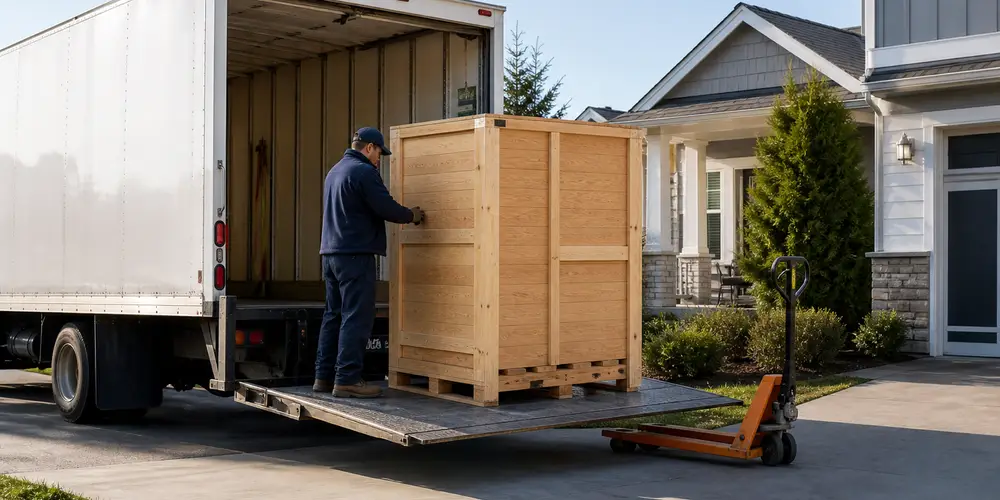
The international move may be only part of the challenge when importing furniture, equipment, stone, fixtures, or other bulky cargo from China. The final delivery can change significantly depending on whether the destination is a commercial dock, a 3PL warehouse, a jobsite, or a residence.
A postcode alone is not enough to plan this step. The quote also needs the address type, truck access, receiving hours, unloading equipment, largest piece, and heaviest piece. If those facts are missing, the delivery method—and its cost—may have to change after arrival.
Residential vs. Commercial Is an Operating Condition
A commercial address is not simply an address associated with a company. For freight planning, the important question is what the driver and vehicle will encounter.
A delivery location may operate like a commercial freight facility when it has:
- Regular business receiving hours
- A loading dock or ground-level forklift access
- Space for the planned truck to enter, turn, and leave
- Staff and equipment ready to unload
- Clear appointment and receiving procedures
A home office, farm, small shop, construction site, or business registered at a house may still require residential or limited-access handling. The carrier or delivery partner determines the applicable service from the actual location and delivery conditions, not only the company name entered on the quote form.
No Dock or Forklift: Tell the Forwarder at Quote Stage
If the destination has no loading dock or forklift, tell the forwarder when requesting the quote. Ask whether a liftgate-equipped truck can be arranged for the packed cargo and delivery postcode. When that service is available and suitable, the applicable liftgate delivery charge should be included in the written delivery quote before booking.
Freight can sometimes be delivered to a site without a loading dock or forklift, but the cargo and site must fit the planned unloading method. Do not wait until the truck arrives to disclose the missing equipment or decide how the freight will leave the vehicle.
| Cargo and site condition | Starting option to review | Important limit to confirm |
|---|---|---|
| Suitable pallet or crate; firm, level ground | Request a liftgate truck in the initial quote | Platform dimensions, piece weight, balance, availability and ground clearance |
| Long, top-heavy or unusually heavy crate | Site forklift, crane, specialized truck or warehouse transfer | Equipment capacity, fork entry, rigging and safe operating space |
| Many loose cartons | Planned receiver labor or a separately arranged handling service | Driver labor is not assumed; confirm waiting time and delivery point |
| Full container but residence cannot receive it | Devanning at a warehouse, followed by a suitable final-mile truck | Warehouse handling, palletizing, storage and second delivery |
| Street or property cannot accept the planned truck | Smaller-vehicle transfer or another approved delivery point | Added handling, address restrictions, permits and redelivery exposure |
| Receiver wants to collect the freight | CFS, terminal or 3PL pickup if offered | Release status, free time, appointment, identification, vehicle and loading help |
Send photos or video of the entrance, road, gate, unloading area, dock, forklift, and largest cargo pieces when access is uncertain. The delivery provider must still confirm what equipment and service are available for the postcode.
What Liftgate Service Actually Does
A liftgate is a powered platform mounted on the back of a suitable delivery truck. It lowers freight between the truck bed and ground level when the receiver does not have a loading dock.
Liftgate service can be useful for palletized cargo, but it is not a universal unloading solution. Before confirming it, the delivery team may need to review:
- Pallet or crate length and width
- Total weight and weight distribution
- Whether the freight fits safely on the platform
- Whether the cargo can remain upright
- Ground conditions where the platform will lower
- Whether a pallet jack can move the load after it reaches the ground
Long crates, top-heavy equipment, loose cartons, fragile stone, or freight exceeding the available equipment limits may need another plan. That could mean a truck with different equipment, a forklift arranged at the site, delivery to a warehouse, or professional rigging. Availability and limits must be confirmed for the shipment and destination.
A Forklift Changes the Plan—If It Is the Right Forklift
Saying “we have a forklift” is helpful, but a reliable delivery plan requires more detail:
- Rated lifting capacity
- Fork length and spacing
- Maximum lift height
- Whether the crate or pallet has usable fork-entry points
- Surface condition between the truck and receiving area
- Operator availability at the appointment time
- Whether the forklift can reach the truck safely
The heaviest individual piece matters more than average weight. A shipment weighing 4,000 lb in total may still be manageable as several pallets, while one concentrated 4,000 lb machine may require heavier equipment and a different vehicle.
Do not assume that a forklift automatically eliminates every delivery charge. Appointment, waiting, limited access, remote postcode, or vehicle restrictions may still apply.
Loading Dock, Curbside, and Inside Delivery Are Different
These terms should be confirmed in writing because they describe different work.
| Delivery condition | Typical scope to confirm |
|---|---|
| Loading-dock delivery | Truck backs to a suitable dock; receiver unloads with staff or equipment |
| Liftgate delivery | Suitable freight is lowered from the truck to accessible ground level |
| Curbside delivery | Freight is delivered to a safe accessible point near the vehicle, not moved through the property |
| Inside delivery | Additional labor or equipment may be needed to move freight beyond the normal delivery point |
| Jobsite delivery | Access, surface, appointment, safety rules, and unloading plan require review |
| Warehouse or 3PL | Appointment number, receiving rules, labels, pallet standards, and delivery documents may be required |
A freight driver should not be assumed to provide manual unloading, installation, assembly, room-of-choice placement, debris removal, or rigging. If any of those services are needed, request them before booking so feasibility and scope can be checked.
Manual Unloading and Driver Waiting
Manual unloading is an operating plan, not a default driver duty. Confirm who supplies the labor, how many pieces must be handled, each piece’s weight, the allowed unloading time, and where the cargo will be placed. If the receiver expects to unload loose cartons by hand, the carrier must agree to the vehicle, appointment, waiting allowance, and safe delivery point in advance.
If unloading cannot be completed within the agreed time, waiting, storage, return-to-terminal, or redelivery may apply. A phone conversation is not enough for unusual unloading requirements; put them in the quote and delivery instructions.
Truck Access Can Decide Whether Delivery Is Possible
The delivery vehicle selected for linehaul efficiency may not fit every street or property. Check the site before requesting the quote:
- Road width, turning radius, and overhead clearance
- Gated-community or building restrictions
- Steep, soft, gravel, or uneven surfaces
- Low branches, wires, awnings, or parking structures
- Legal parking and safe unloading space
- Local time restrictions or permits
- Distance from the truck to the intended receiving point
If a full-size vehicle cannot enter, the freight may need transfer to a smaller truck or a different delivery point. This can add handling, time, and cost, so accurate access information is more useful than discovering the restriction when the driver arrives.
When Terminal or Warehouse Pickup Is Better
Self-pickup can be useful when home access is unsuitable or the importer has the correct vehicle and unloading resources. It is not the same as collecting a parcel from a retail counter.
Before choosing pickup, confirm:
- Whether the CFS, terminal, or warehouse releases freight directly to the consignee
- Customs and carrier release status
- Appointment, identification, pickup number, and operating hours
- Free time and storage after availability
- Whether cargo is loose, palletized, or crated
- Whether the facility loads the customer’s vehicle and what equipment it can handle
- Vehicle deck height, payload, securing equipment, and weather protection
- What happens if the vehicle is unsuitable or the pickup is missed
For many first-time importers, delivery through a suitable 3PL or local warehouse can be safer than improvising at the terminal. Compare the handling and second-delivery cost with the equipment and risk required for self-pickup.
Why Appointments, Waiting, and Redelivery Matter
Many freight deliveries require an appointment rather than an exact parcel-style delivery window. The receiver should provide a working contact, answer scheduling calls, and ensure the site is ready.
Extra work can arise when:
- The receiver cannot be reached
- The appointment number or purchase order is missing
- The site refuses the freight
- Unloading equipment or labor is unavailable
- The driver waits beyond the included time
- The address changes after dispatch
- A second delivery attempt is required
Ask how appointment, waiting, storage, address correction, and redelivery are handled in the written quote. A clear quote identifies known conditions; it cannot remove costs caused by facts or events that were not available when the shipment was planned.
Packaging Must Match the Final Delivery Method
International transport packaging also needs to survive final-mile handling. For bulky or fragile freight, consider:
- A pallet or crate designed for the actual weight
- Fork-entry points that remain accessible
- Blocking and bracing to prevent movement
- Edge, corner, moisture, and surface protection
- Strapping suitable for the cargo
- Compliant wood packaging where applicable
- Visible handling marks where they are operationally necessary
- Photos of the completed packaging before pickup
Carrier liability may be limited and is not the same as cargo insurance for full commercial value. High-value, fragile, or unusual cargo should be reviewed for separately confirmed insurance, including insured value, exclusions, deductible, and packaging conditions.
Information to Send With Your Freight Quote Request
Provide these details before the shipment leaves China:
Cargo
- Commodity and commercial use
- Piece count and packaging type
- Dimensions and weight of every large piece
- Total weight and volume
- Largest and heaviest individual piece
- Stackability, fragility, and declared value
- Clear photos of the cargo and final packaging
Destination
- Full postcode and address type
- Business, warehouse, 3PL, Amazon, residential, or jobsite
- Loading dock and forklift availability
- Liftgate or appointment request
- Truck-access restrictions
- Receiving hours and onsite contact
- Manual unloading, inside movement, or special placement needs
Shipment plan
- Cargo-ready date
- Air, LCL, FCL, or request for a recommendation
- Single or multiple suppliers
- Importer and customs arrangement
- Any required delivery deadline
The Practical Takeaway
Our completed furniture shipment from Zhejiang to Virginia documents one actual delivery sequence: 56 CBM in a 40HQ container, destination warehouse devanning, and final delivery by a truck equipped with a liftgate. It records signed delivery without claiming inside placement or assembly.
Residential freight delivery is possible for some shipments, but it should not be treated as ordinary parcel delivery. The right plan depends on the packed cargo, delivery vehicle, unloading equipment, property access, and services requested.
For comparison, our 6.5 CBM LCL shipment to Florida was delivered to a commercial address where dock or forklift availability had been confirmed. That receiving condition differs from a residence with no unloading equipment and is one reason the destination type must be disclosed before quoting.
Final-Mile Delivery Questions Importers Ask
Will the driver wait while I unload the cartons myself?
Only if that unloading method and the applicable waiting allowance have been accepted in advance. Do not assume unlimited driver time or manual help merely because the shipment is door-to-door.
Does liftgate service move freight into my garage or building?
Normally, liftgate describes lowering suitable freight between the truck and accessible ground level. Request it when confirming the freight quote so suitability, availability and the delivery surcharge can be included in writing. Inside movement, room-of-choice placement, installation and long-distance movement require separate confirmation.
Can I pick up LCL cargo from the freight terminal?
Sometimes, after customs and carrier release and only when the facility permits consignee pickup. Confirm the appointment, free time, loading support, cargo configuration and vehicle requirements before selecting this option.
If you are importing furniture, equipment, fixtures, stone, or other non-standard freight, review our bulky commercial cargo solution and freight quote checklist. When the details are ready, request a shipment-specific delivery review.