
How to Pack Bulky Commercial Cargo From China
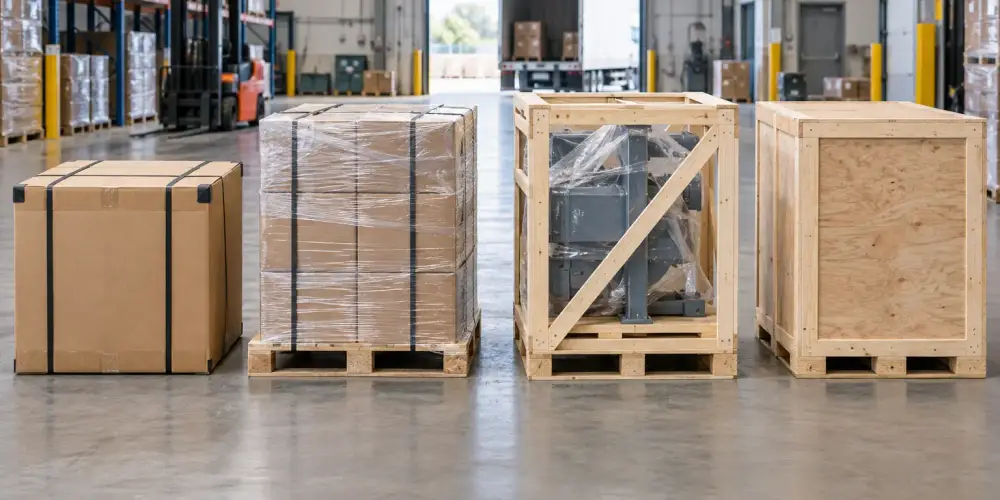
Bulky commercial cargo should be packed for the entire handling chain, not only for the trip from the factory to a China warehouse. The right choice depends on the item’s packed size, gross weight, fragility, lifting points, stackability, international route, and the equipment available at final delivery.
There is no universal rule that every large item needs a closed wooden crate. Overpacking can add chargeable volume and weight; underpacking can leave the cargo unable to tolerate warehouse, container, terminal, or truck handling.
Carton, Pallet, Wooden Frame, or Crate?
| Packaging format | Often considered when | What must be checked |
|---|---|---|
| Reinforced carton | The item is protected internally, manageable as one piece, and suitable for the expected handling | Compression strength, corners, moisture exposure, gross weight, and stackability |
| Pallet or skid | Several cartons need to move as one unit or forklift handling is expected | Pallet footprint, overhang, fork entry, total height, stability, and final delivery equipment |
| Wooden frame | A bulky item needs restraint or edge protection while some surfaces remain visible | Attachment points, exposed areas, center of gravity, lifting method, and treated wood requirements |
| Closed wooden crate | Fragile, high-value, irregular, or sensitive cargo needs greater external protection | Internal blocking, inspection access, gross weight, dimensions, lifting points, and treated wood requirements |
| Custom engineered support | Long, top-heavy, unusually dense, or machinery-type cargo cannot safely use a standard format | Manufacturer instructions and a cargo-specific lifting, restraint, and handling plan |
The table is a screening tool, not a packaging design specification. The shipper or qualified packaging provider should approve the final structure for the actual item.
What Information Should the Factory Put on the Packing List?
Ask for final packed information, not product-only measurements:
- Number of handling pieces
- Length, width, and height of each package type
- Gross weight of each piece and total gross weight
- Largest and heaviest piece
- Packaging material and format
- Whether each piece is stackable
- Fork entry or approved lifting points
- Center-of-gravity or top-heavy warning where relevant
- Fragile, keep-dry, orientation, battery, or other handling attributes
These facts affect LCL warehouse handling, container loading, chargeable volume, truck equipment, and delivery feasibility. If dimensions change after the quotation, the provider may need to remeasure and update the plan.
Does Wood Packaging Need an ISPM 15 Mark?
Regulated wood packaging material entering the United States must meet ISPM 15 requirements. USDA APHIS identifies pallets, skids, crates, boxes, cases, bins, reels, drums, and dunnage among the formats that may be regulated, and explains the required treatment and official mark in its wood packaging import guidance.
Ask the packaging supplier which components are regulated solid wood, whether treatment was performed by an accredited provider, and where the official mark can be inspected. Do not assume that an unmarked frame is acceptable because the product itself is not made of wood. Requirements also depend on the destination country, so Canada and Puerto Rico arrangements should be checked for the actual shipment rather than copied from a U.S. mainland quote.
How Does Stackability Affect LCL Pricing and Risk?
“Non-stackable” means cargo cannot safely support freight above it. That can increase the space reserved in an LCL consolidation and may change the quotation. It can also limit where the piece can be positioned during warehouse and container handling.
Do not mark fragile cargo as stackable merely to reduce the estimated price. Instead, give the provider the permitted top load, orientation, and handling restrictions before the shipment reaches the consolidation warehouse.
What Should Be Recorded Before Pickup?
Create a privacy-safe pre-shipment record:
- Photograph the item and internal protection before final closure.
- Photograph all external sides after packing.
- Record a tape measurement of each dimension.
- Record gross weight using the available warehouse or factory scale.
- Photograph the package ID and any handling marks without exposing customer contact details publicly.
- Record visible condition when the warehouse receives the piece.
- Confirm any repacking or reinforcement in writing before consolidation.
This record does not guarantee a damage-free shipment, but it helps the parties verify what was tendered, what changed, and which evidence may be available if a claim is required.
A Real LCL Packaging Example
For a completed 6.5 CBM multi-supplier shipment to Florida, the Guangzhou consolidation stage included cartons, long pieces, and larger packaged items. Fragile units were given wooden-frame or wooden-crate protection before the combined LCL shipment moved through Tampa for truck delivery.
The case does not prove that the same packaging is correct for every product. It shows why the warehouse needs final piece-level information before deciding what requires reinforcement. Review the Florida LCL case study and authorized photos.
What Changes When the Receiver Has No Dock or Forklift?
Packaging and delivery cannot be planned separately. A heavy crate may be suitable for origin handling but still be impossible to unload from the final truck at a residence or small business.
Tell the forwarder during the quotation stage whether the destination has a dock or forklift. Ask whether a liftgate-equipped truck can handle the packed dimensions and piece weight; when it is available and suitable, the applicable liftgate charge should be included in the written delivery quote. Read our commercial and residential freight delivery guide before confirming the final package size.
Final Packaging Review Before Booking
- Is the packaging suitable for the item and handling chain?
- Are final packed dimensions and gross weights available per piece?
- Are stackability and lifting restrictions written down?
- Is regulated wood packaging properly treated and marked?
- Can the largest piece pass through the planned warehouses and delivery equipment?
- Does the receiver have the dock, forklift, liftgate, labor, and access needed?
- Are high-value or fragile items being reviewed for shipment-specific cargo insurance?
For bulky commercial cargo, use the freight quote checklist and our bulky cargo planning page. You can then request a packaging and route review using the final packed measurements.