
How to Consolidate Orders From Multiple Alibaba Suppliers to the USA
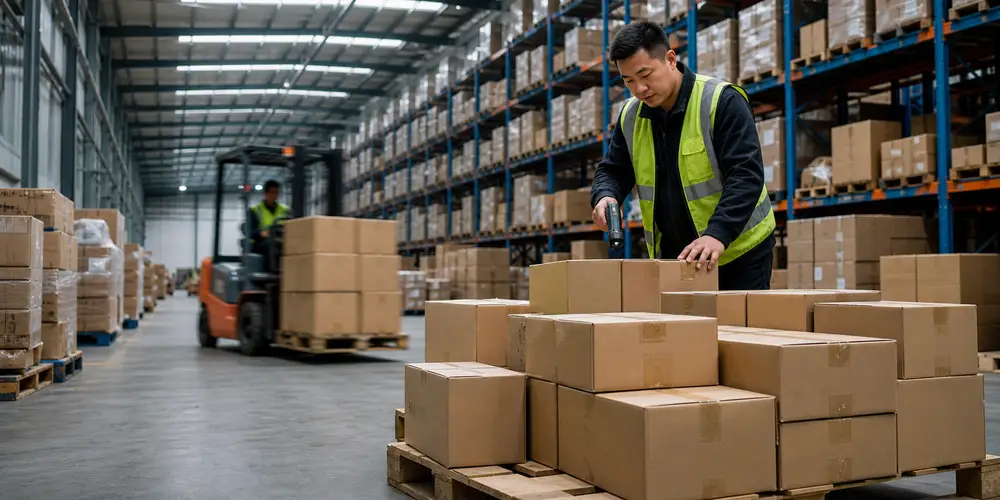
Buying from multiple Alibaba suppliers can give you better product options and pricing, but it can also turn shipping into a mess. If every supplier sends a separate package to the United States, you may end up paying repeated handling fees, managing several deliveries, and losing track of what has actually shipped.
Consolidation is the simpler alternative. Your suppliers send their cartons to one warehouse in China, where they are received, checked, combined, and shipped together as one international shipment.
But consolidation is not simply “put every carton together.” The plan must account for supplier locations, cargo-ready dates, product compatibility, packed dimensions, storage, customs data, and the final delivery address.
How Consolidation Works
The process is straightforward:
- You place orders with two or more Alibaba suppliers.
- Each supplier sends goods to your forwarder’s warehouse in China.
- The warehouse receives and labels each delivery.
- Your cartons can be counted, photographed, weighed, measured, or repacked if needed.
- Once all goods arrive, the shipment is consolidated.
- Your forwarder arranges air freight, LCL ocean freight, or FCL ocean freight to the United States.
- Customs clearance and final delivery are arranged based on your shipping terms.
Instead of coordinating multiple international shipments, you manage one shipment from China to your destination.
The exact warehouse service must be agreed in advance. Receiving cartons does not automatically include product inspection, functional testing, repacking, palletizing, storage, labeling, photography, or damage verification.
Why Importers Consolidate Alibaba Orders
The biggest benefit is avoiding duplicate shipping costs. Separate shipments can each carry their own export handling, international freight, customs, and final-mile delivery charges. Combining the goods gives you a clearer view of the final shipment size and more flexibility to choose the right shipping method.
Consolidation also gives you a useful checkpoint before the cargo leaves China. Depending on the service arranged, you can confirm:
- How many cartons arrived from each supplier
- Whether outer cartons are damaged
- Final weight and dimensions
- Whether repacking can reduce unnecessary volume
- Whether all suppliers have delivered before booking freight
This is especially useful when suppliers are located in different Chinese cities or have different production schedules.
When Consolidation May Not Save Money
Combining orders is useful, but it is not automatically cheaper in every situation. Separate shipping may still make sense when:
- One supplier finishes much later than the others and holding the early cargo creates storage or stockout costs.
- The products cannot share the same handling or transport channel.
- One order is urgent enough to justify air freight while the rest can move by ocean.
- Extra pickups and long domestic distances in China exceed the savings from one international shipment.
- The combined cargo becomes bulky, non-stackable, or difficult to load efficiently.
- A supplier already offers a commercially workable shipping arrangement that should be compared with the consolidated option.
Ask for a comparison using the same destination and delivery scope rather than assuming consolidation always wins.
What Information Should You Prepare?
Before your suppliers send goods to a consolidation warehouse, provide your forwarder with:
- Supplier names and contact details
- Supplier pickup cities or warehouse addresses
- Product descriptions and intended use
- Whether products contain batteries, liquids, magnets, cosmetics, or branded goods
- Estimated carton count, weight, and dimensions
- Total cargo value
- Destination city and ZIP code
- Preferred delivery timeline
- Whether delivery is going to a warehouse, business, residence, or Amazon FBA location
Your forwarder can usually give an initial shipping plan before all goods arrive, then confirm the final chargeable weight and quote after consolidation.
For every supplier, it helps to maintain a simple cargo schedule containing:
| Supplier | Pickup city | Cargo-ready date | Pieces | Packed dimensions | Weight | Commodity | Special attributes |
|---|---|---|---|---|---|---|---|
| Supplier A | Confirm | Confirm | Confirm | Confirm | Confirm | Confirm | Confirm |
This makes missing data visible before cargo reaches the warehouse.
Air Freight or Ocean Freight?
The best option depends on your shipment size, budget, and deadline.
Air Freight
Air freight is usually the better choice when your shipment is relatively small, time-sensitive, or high-value. It is often a practical option for consolidated Alibaba orders that are too large for normal courier service but do not justify ocean freight.
LCL Ocean Freight
LCL, or Less than Container Load, is usually better for larger or heavier shipments when delivery time is flexible. Your cargo shares container space with other importers’ goods, which can make it more cost-effective than air freight for smaller commercial volumes.
FCL Ocean Freight
FCL, or Full Container Load, is the best fit when your cargo fills most or all of a 20ft or 40ft container. As shipment volume grows, FCL often becomes more economical per unit and gives you greater control over the container.
There is no universal CBM number at which FCL always becomes cheaper. Origin charges, current rates, cargo density, long pieces, destination charges, and unloading conditions can move the crossover point. When the combined volume is approaching container economics, request both an LCL and FCL comparison. See our detailed FCL vs. LCL decision guide.
What Should Be Checked at the China Warehouse?
Depending on the service purchased, a consolidation checkpoint can confirm:
- Outer-carton count and visible carton condition
- Shipping marks and supplier identity
- Actual packed dimensions and weight
- Whether packages are stackable
- Whether palletizing, crating, or protective packaging is required
- Whether declared cargo matches the received labels and documents
Do not confuse a receiving check with a product-quality inspection. If you need quantity verification inside cartons, functional testing, specification checks, or factory-quality control, define that as a separate service before the cargo arrives.
What Happens If One Supplier Is Late?
A late supplier does not automatically mean that every order must wait. The practical decision is whether the value of keeping the shipment together is greater than the storage, stockout, rebooking, or split-shipment cost created by the delay.
Use this decision process before the planned shipping cutoff:
- Confirm what “late” means. Ask for the remaining production steps, final packing date, pickup city, and a realistic cargo-ready date—not only “almost finished.”
- Check the warehouse position. Confirm which suppliers have arrived, the free-storage allowance, the daily charge after free time, and whether the received cargo is already measured and ready to ship.
- Protect the business deadline. Identify which products are needed first. An urgent SKU may justify leaving by air or as a separate LCL shipment while replenishment stock waits.
- Compare complete revised options. Request the cost and timing impact of waiting, shipping the ready cargo now, or dividing the order by transport mode. Each option should include any extra pickup, storage, handling, customs, and final-delivery scope.
- Approve one written cutoff. Tell every supplier and the warehouse which orders belong to the current shipment and which will roll to the next one. Update the packing list and commercial invoice to match the cargo that actually ships.
| Situation | Starting decision | What to confirm |
|---|---|---|
| Delay is short and no stockout is expected | Hold and consolidate | Storage allowance, booking cutoff, revised ready date |
| One product is commercially urgent | Split the urgent cargo | Air or separate LCL cost, customs documents, delivery priority |
| Late cargo would force a missed sailing or long storage | Ship ready orders | Revised volume, LCL/FCL choice, documents that exclude the delayed order |
| Several suppliers remain uncertain | Move to a staged plan | First-shipment cutoff, later consolidation window, duplicate fixed charges |
| Delayed cargo changes container utilization | Recompare LCL and FCL | Final packed volume, weight, loading plan, destination scope |
Do not reserve space from optimistic factory dates alone. Build a small buffer between the last confirmed cargo-ready date and the warehouse or carrier cutoff, especially when several pickups and document sets must be coordinated.
Before sending goods to the warehouse, also ask when final measurements will be available, whether repacking requires approval, and which documents must match across suppliers.
Important Questions to Ask Before Shipping
Before selecting a consolidation provider, make sure you understand what the quote includes.
Ask whether the price covers:
- Warehouse receiving and consolidation
- Repacking, palletizing, or carton inspection
- Export handling in China
- Air or ocean freight
- Customs clearance
- Duties and taxes, if applicable
- Destination handling charges
- Final delivery to your address
Also ask about free storage time. If one supplier delivers early and another is delayed, storage charges can add up if the warehouse only offers a short free period.
For U.S. delivery, confirm whether the destination is a commercial dock, 3PL, Amazon facility, construction site, or residence. Postcode, appointment, liftgate, forklift, truck access, and unloading labor can affect the quote independently of the ocean or air rate.
Common Mistakes to Avoid
Do not compare quotes based only on a per-kilogram or per-CBM rate. A low freight rate can look attractive while excluding destination fees, customs handling, or final delivery.
Do not ignore chargeable weight. Air freight is generally charged using the higher of actual weight or volumetric weight, so large but light cartons may cost more than expected. Repacking before shipment can sometimes reduce this cost.
Finally, always provide accurate product descriptions and values. Goods such as batteries, liquids, cosmetics, branded products, and food-contact items can require different handling or documentation. A reliable forwarder should know the real cargo details before booking.
Do not ask a supplier or forwarder to lower the declared value or use a vague description to make consolidation easier. U.S. Customs and Border Protection emphasizes that importers remain responsible for accurate entry information even when a customs broker is used. See CBP guidance for new importers.
Consolidation Questions Importers Ask
Can goods from different factories use one commercial invoice?
The document structure depends on the sellers, buyer, customs entry, and transaction records. Do not merge supplier data merely to make the shipment look simpler. Give the licensed customs brokerage partner the real seller, product, value, origin, and purchase information so the correct entry documents can be prepared.
Should the early supplier send cargo to the warehouse immediately?
Only after the receiving address, shipping marks, free-storage period, warehouse services, and expected consolidation date are confirmed. Otherwise, an early delivery can create avoidable storage or handling costs.
Can one consolidated order use both air and ocean freight?
Yes, when the cargo and documentation support a split plan. Importers sometimes move urgent items by air and send the remaining commercial stock by LCL or FCL. Compare the additional fixed charges with the cost of waiting for the entire order.
The Bottom Line
Consolidating Alibaba orders gives small and mid-sized importers a more organized way to ship from China. It can reduce duplicate costs, simplify customs and delivery coordination, and give you more control before your goods leave the warehouse.
Our completed 6.5 CBM LCL shipment from Guangzhou to Florida shows how multiple supplier orders and fragile pieces were combined, measured, protected with wooden frames or crates where needed, cleared, and delivered to a commercial address. It is an operating example, not a promise that every consolidated shipment follows the same route or timing.
At landfallfreight, we coordinate China-origin supplier pickups and consolidation, then compare air freight, LCL and FCL ocean freight, and eligible destination-delivery options within a written scope.
Review our multi-supplier consolidation solution or get a detailed quote with product type, supplier cities, cargo-ready dates, cartons, weight, dimensions, destination ZIP code, and delivery conditions.